The Add-On Years — How Sega Sold Three Consoles to the Same Kid
By Guilherme · 2026-09-06
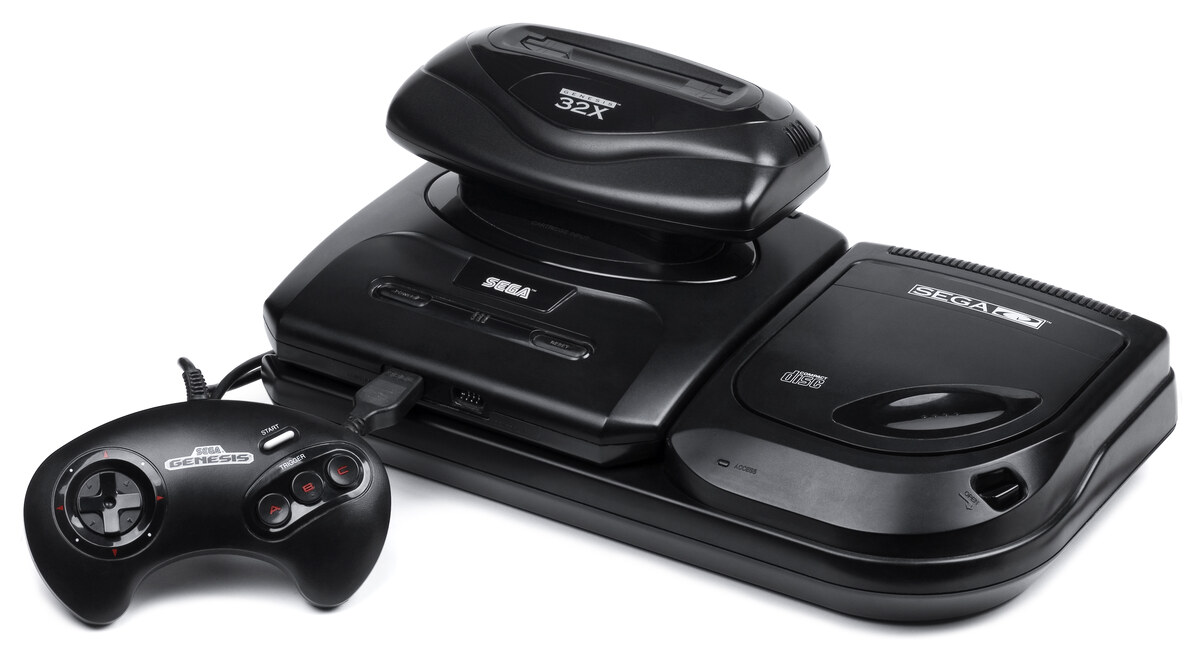
When Tec Toy put the 32X in Brazilian stores in 1995, I was a kid with a Mega Drive and one Sonic cartridge I'd already played until there were no secrets left in it. I was fascinated by the idea that a single accessory would make that console do polygonal graphics and show more colors than a Super Nintendo. There was just one problem: there was no chance at all of asking my father for something that cost R$299 at the time. And since the 32X was never popular here either, I only got to know its library years later — first through emulators, then when I started collecting.
The 32X games on my shelf today arrived in all sorts of ways. Many were practically given away, back when retro games were worth nothing. Others I had to hunt down and pay dearly for, like Knuckles' Chaotix. And a few, like the rare Spider-Man: Web of Fire, I already know I'm never going to own.
The 32X is really not much more than the physical form of the confusion Sega fell into in the mid-90s, with its Japanese and American arms fighting each other. Asked to choose between betting on the Saturn and buying the Mega Drive more time, the company did both: it built a product that competed with itself and confused its own installed base.
Between 1991 and 1994, Sega tried to get the same family to buy three things: a Mega Drive (the Genesis in the US), a Sega CD, and a 32X. By the time the third one showed up on shelves, the Saturn — the Mega Drive's actual successor — was already selling out in Japan. Sega didn't lose the console war of the mid-90s because Nintendo or Sony out-engineered it. It lost because it kept asking the same customer to pay for the future in installments, and by the time the real next-generation console arrived, that customer had already spent the money, the patience, or both.
A Console, Then a Peripheral, Then Another Peripheral
The Sega CD launched in Japan on December 12, 1991, as the Mega-CD, and reached the US on October 15, 1992, at $299 — nearly the price of a whole second console. It promised CD-quality audio, full-motion video, and a library that would eventually top 200 titles. In practice, for all the genuinely good games on it, the thing leaned hard on FMV — which, personally, I find awful.
Two years later, Sega did it again. The 32X landed in North America on November 21, 1994, at $159.99, adding a pair of 32-bit SH-2 processors to the aging Mega Drive. It was pitched, explicitly, as the cheap way in: for less than half the Saturn's $399, an existing Mega Drive owner got something the ads implied was 32-bit gaming, with no new console required. On paper, that's a reasonable value proposition. What made it incoherent wasn't the price — it was that Sega made this pitch at the exact moment its own next-generation console was already on sale in Japan.
It would even have made sense if the 32X had been something else: an add-on that, bolted onto a Mega Drive, ran Saturn games for less money. That would have been a ladder — people who already owned a Mega Drive paying a little to step into the new generation, and newcomers buying a Saturn, a separate console that played both the new games and the old ones. None of that was what was for sale. The 32X had its own library, incompatible in both directions, and it didn't talk to the Saturn at all.
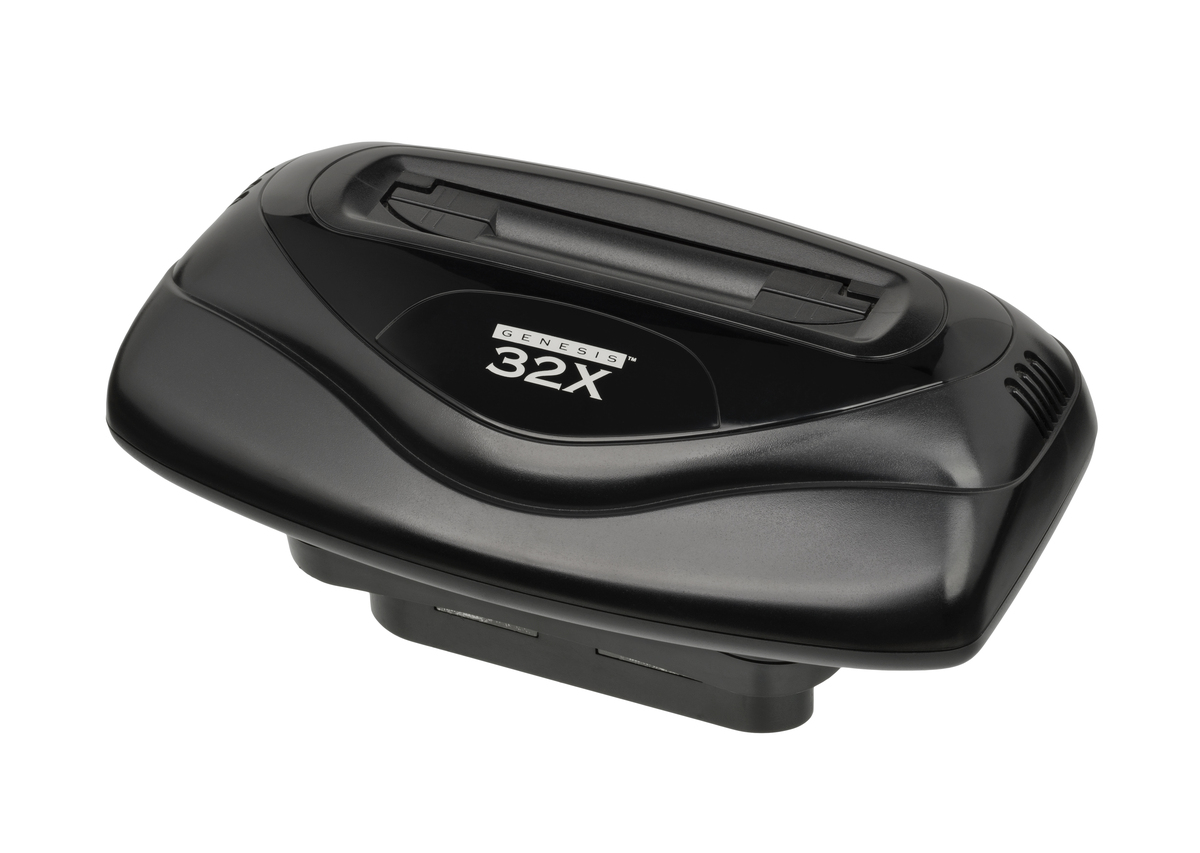 Photo: Evan-Amos, public domain, via Wikimedia Commons.
A Small Library of Questionable Quality
For all those 32 bits, almost nothing shipped to prove what the machine could do. The entire library came to 40 games worldwide, six of which needed a Sega CD as well to run. Which means: to play those six, you spent roughly $459 on accessories, on top of a Mega Drive that was already yours. At the North American launch Sega had promised twelve titles; only six arrived.
Among the forty: Doom, Virtua Racing Deluxe, Knuckles' Chaotix, Space Harrier, After Burner, Star Wars Arcade, and a port of Virtua Fighter. It's not a bad list — it's far too small a list for a system to sell itself on.
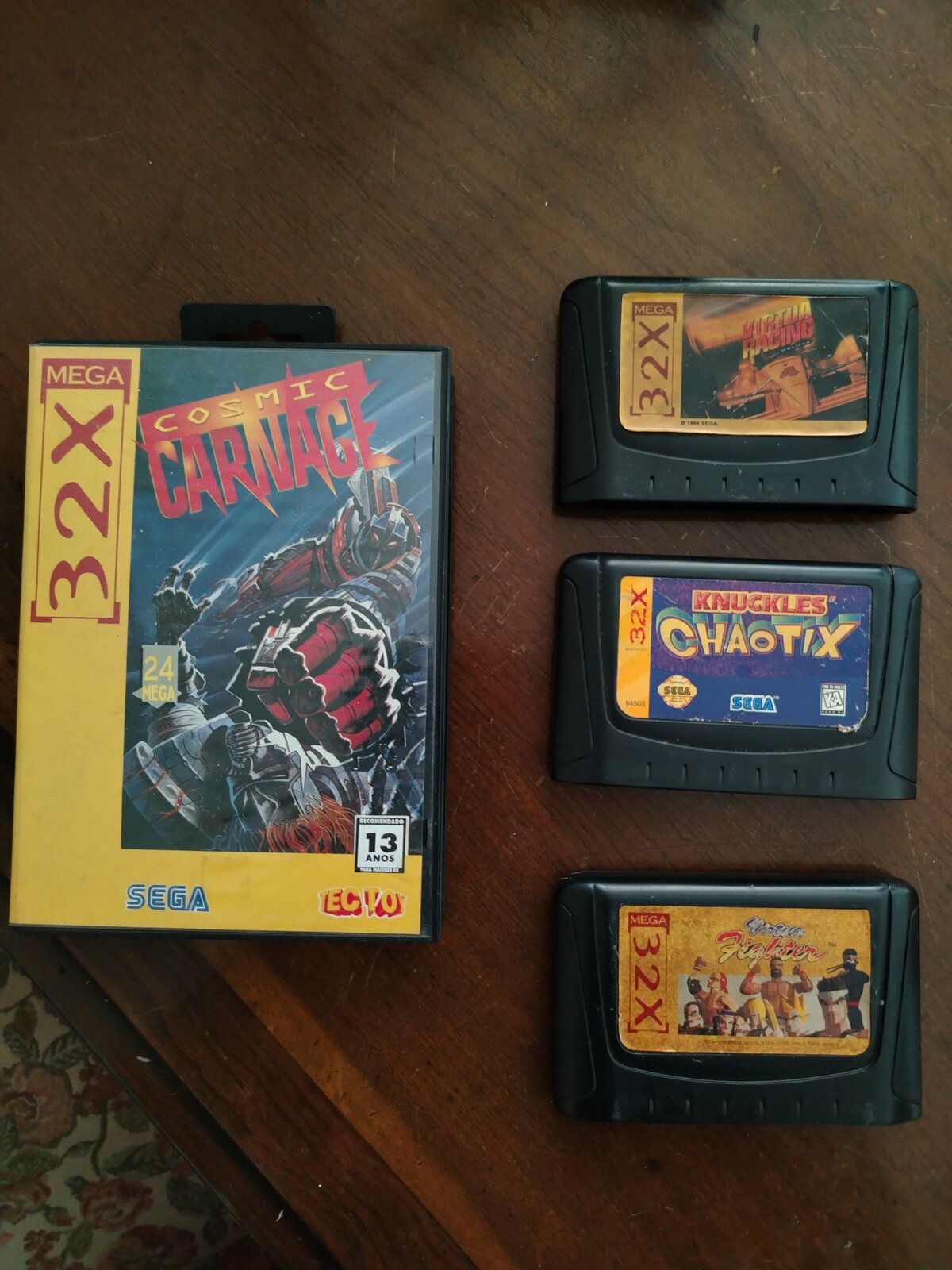 From my collection: a boxed Tec Toy copy of Cosmic Carnage, plus Virtua Racing, Knuckles' Chaotix and Virtua Fighter.
The Saturn Was Already Real
The strategic confusion wasn't an accident of timing — it was a decision, made and later regretted out loud. Shoichiro Irimajiri, who held senior roles at both Sega of Japan and Sega of America through the 1990s, described the overlap in a 2022 lecture later translated into English by Mega Drive Shock: Sega of America insisted on releasing the 32X ahead of the Saturn's US launch, specifically to protect Genesis momentum a while longer — a decision that pushed the Saturn's American release back by roughly a year from what Sega of Japan wanted. "It turned out to be a huge strategic blunder," Irimajiri said, "and it would cost us heavily until the very end." American third-party developers, watching Sega ship a Genesis add-on and a full next-generation console within months of each other, read the confusion correctly and largely moved toward Sony instead.
What $100–200 Million Actually Paid For
The 32X's commercial failure is usually cited alongside a specific, alarming dollar figure — and it's worth being precise about what that figure actually measures, because the popular version overstates it. In the same 2022 lecture, Irimajiri described Sega of America's finances collapsing under the weight of American retail's return policy: stores like Toys "R" Us and Walmart could ship unsold stock back to Sega, and Sega had to eat the cost. "Those extraordinary losses came to $100 million or $200 million at a time," he said — but he was describing the broader pattern of returned Genesis-era inventory across 1994 through 1996, not a 32X-specific write-off. The 32X's own sell-through was part of what fed that hole — sources disagree sharply on how much of it: Wikipedia's 32X entry, citing Keith Stuart's Sega Mega Drive Collected Works, puts worldwide sales at roughly 665,000–800,000 units by the end of 1994, while a fan researcher's compilation of contemporary magazine reports (Game Players, Man!ac) arrives at a lifetime total closer to 1.23 million. Sega itself never published an official number. Either way, the 32X was a contributor to that systemic loss, not its sole cause — the real damage was a retail relationship Sega had already broken before the 32X ever shipped.
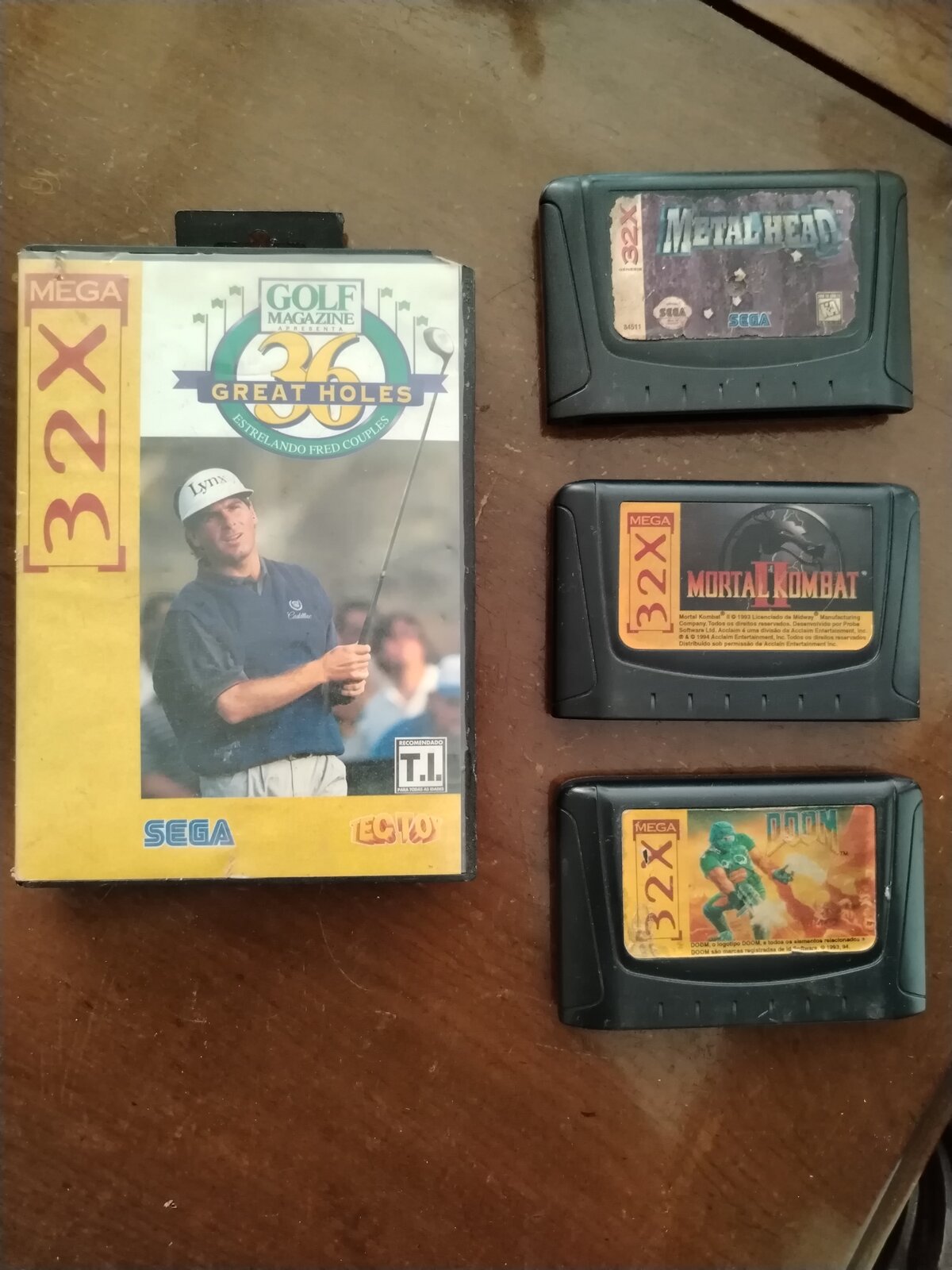 More from my shelf: Tec Toy's Brazilian release of Golf Magazine: 36 Great Holes ("estrelando Fred Couples"), next to Metal Head, Mortal Kombat II and Doom. Most of them carry Tec Toy's yellow "Mega 32X" label.
The Sega Neptune
Curiously, Sega did consider a console called the Sega Neptune: the Mega Drive and the 32X together, in a single box. It was announced and then quietly canceled before release. A company that ships an add-on, plans to merge that add-on into the console it's an add-on for, and cancels the merger while a genuinely new console is already on store shelves in another country is not executing a strategy — it's improvising one, in public, on a retailer's shelf.
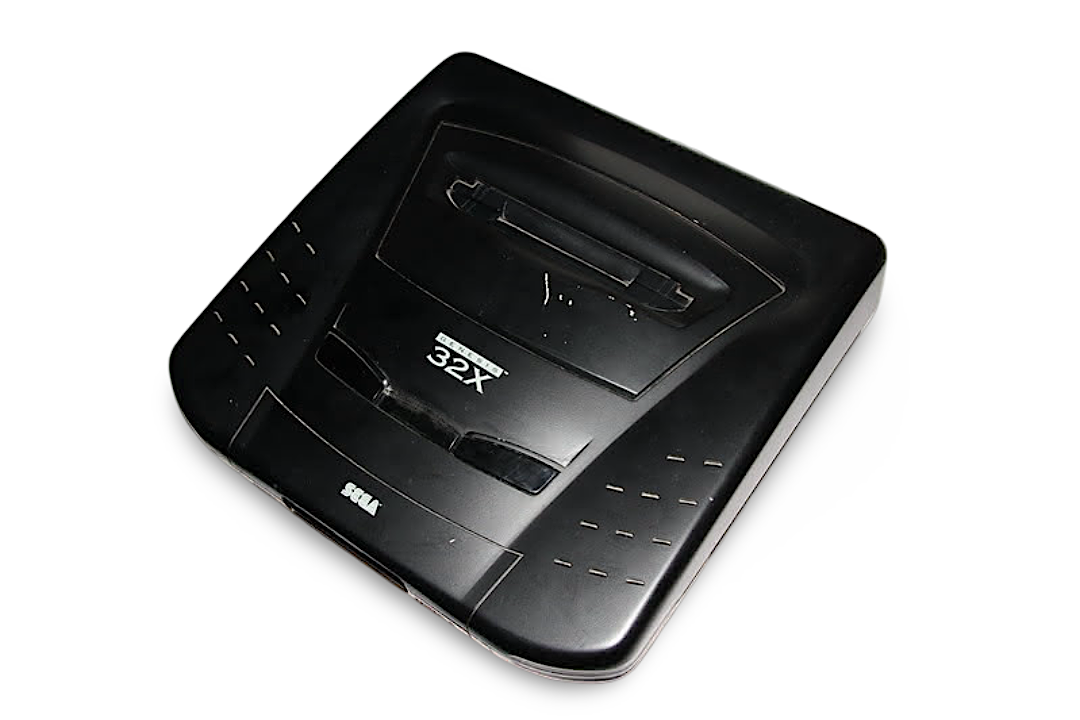 Illustration: a modern fan rendering of Sega's canceled 1995 Neptune concept — not a period photograph of the actual wood-and-plastic mockup (which exists as a single unit at the National Videogame Museum), and not related to GamesCare's GF-1 Neptune, the modern FPGA console described below. Electroanalog, CC0, via Wikimedia Commons.
Someone Is Finally Building the Neptune
The Neptune spent thirty years as exactly that: Sega built one non-functional wood-and-plastic unit, which now sits at the National Videogame Museum. It was never a working product, on Sega's part or anyone else's. That's starting to change. On July 1, 2025, GamesCare — a São Paulo hardware repair and modification shop, unaffiliated with Sega — announced the GF-1 Neptune: an unlicensed, FPGA-based console in development, designed to play original Genesis/Mega Drive and 32X cartridges natively in a single box, with Master System support via an adapter, a Sega CD connector for the original add-on, HDMI output, digital and analog audio, an SD card slot, and network connectivity for updates and a planned storefront for indie Genesis games. It's not an emulator — FPGA hardware reconfigures itself to behave like the original chips at the circuit level, the same approach Analogue uses in its own reproduction consoles.
A prototype was first playable in public at RETROCON 2025, July 25–27 at São Paulo's Transamérica Expo Center, running a homebrew shooter called Sword of the Apocalypse. No commercial version exists yet: a December 2025 release window slipped to 2026 when GamesCare said it wanted independent reviewers to test finished hardware before taking a single pre-order — no crowdfunding, no hype cycle, just an email list at gf1neptune.com. Whether or when it actually ships is still an open question as of this writing.
Where to Follow the GF-1 Neptune
News about the console usually goes out through GamesCare's own channels:
- Instagram: @gamescarebr
- YouTube: @GamesCareBR